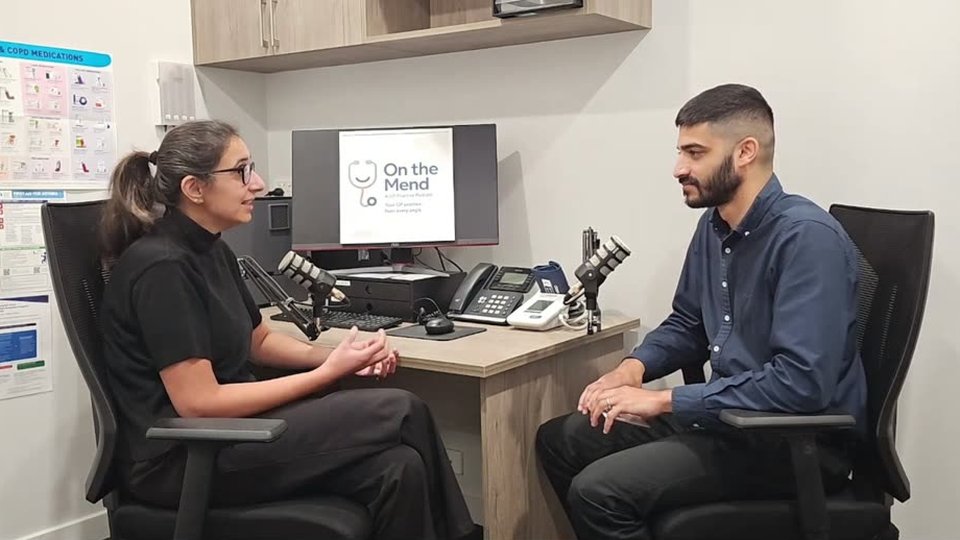
A lightly edited transcript of the conversation with Dr Vinny Lam, who practises at Balwyn Central Medical. General information only, not personalised medical advice. If you have been injured at work, speak with your GP.
Host: Welcome to On The Mend, a short video podcast that takes you behind the scenes of your general practice. A quick note before we start: everything we discuss is general information only. It is not tailored medical advice and does not replace a conversation with your health practitioner. If something is on your mind, please consult your GP. You can find us here in the waiting room or on YouTube or Spotify. And with that, let's get into it.
Host: Welcome back to On The Mend. Today we're joined by Dr Vinny Lam, who is a Fellow of the Royal Australian College of General Practitioners. Dr Vinny has experience working across the Gold Coast, Sydney and Melbourne, and he has a special interest in occupational health and general family health. That's why we've got him on the podcast today, to give us some insight into occupational health and WorkCover, and what patients should know before they come and see the doctor. So let's start with the general question. What exactly is occupational health, and why should people care about it?
Dr Vinny Lam: Good question. Occupational health is about making sure the workplace is safe, and also making sure that people who do get injured at work are able to return to work in a safe and controlled manner. Whether you've had an injury or accident at work, say you've hurt your knee, you need to see a doctor and get the right rehabilitation plan so you can get back to work safely.
Host: So you're not climbing ladders the next day once you get back to work.
Dr Vinny Lam: At least in some capacity, whatever that might mean for the patient.
Host: And that's not only for people in physical jobs. It can be someone with a desk job as well, right?
Dr Vinny Lam: Yes. Work injuries can occur in any sort of workplace. Even just sitting in a chair like this, people can get neck strain, back strain and things like carpal tunnel from typing too much.
Host: Typing and writing. So when it comes to WorkCover and occupational health, what's one of the biggest mistakes people make in the first 48 hours after an injury at work?
Dr Vinny Lam: I think it comes down to two main things. The first is that people don't report it to their line manager, so the workplace doesn't know it has happened. It's important to make sure your boss knows. You tell your boss, "I've hurt myself." The second is pushing through it. Say you hurt your shoulder on the job and you keep using it for another three, four or five days, and it just gets worse. At that point it's very hard to tell when the injury actually happened, or whether it's getting worse because you've pushed through it. You don't want that to happen.
Host: And that's why the initial documentation is important. You start the timeline, and it makes it very clear for the insurer, the workplace and the doctor, so all the timelines align. It's not so much for the treatment, it's for the admin side, so you get looked after.
Dr Vinny Lam: That's right. Make sure you have the date of the injury and the mechanism, so exactly what happened or what led to the injury. Also note down anything that happened before the injury. If you've had previous back injuries, for example, that might have made you more likely to hurt it.
Host: So from an admin side, what should a patient know when dealing with WorkCover?
Dr Vinny Lam: The most important thing is to document everything: the date of the injury, how it happened, and then telling your boss or line manager. You need a paper trail, otherwise it becomes very hard to manage. Once you have all of that, come and see a doctor, or if it's an emergency, get help straight away. We can manage it, and then we'll organise a certificate of capacity. Make sure you tell your line manager as soon as possible after that.
Host: So what happens once a certificate of capacity is created and signed?
Dr Vinny Lam: A certificate of capacity is a document with your name, the date of the injury, what the injury or diagnosis is, and what you can and can't do in relation to work. That covers things like sitting, standing and walking. Say you've injured a knee, we wouldn't want you walking for more than an hour or two. It will be very specific to the injury. The certificate also has dates, so the period we expect you to be on reduced or altered duties, or if you're not able to work at all, we can write that down as well. Each certificate needs to be renewed every two to four weeks, depending on the injury, and you come and see your GP for that.
Host: So the GP advises on the review points based on the type of injury. And can a medical certificate be used in the same way?
Dr Vinny Lam: No. A medical certificate doesn't outline what the patient can and can't do. A certificate of capacity is a legal document your employer needs to follow to support a safe return to work, and it's very clear on all the different things: sitting, standing, lifting, twisting and bending.
Host: And on top of that, a patient would need a claim number, and to know which insurance company they're dealing with and the contact there. That helps on the admin side of the practice, and for you, so you know where to send your certificates and can still get paid if you're off work, or so your workplace can manage your duties. We also see it from the admin side when it comes to getting consultations paid, because these consults aren't covered by Medicare. Is that right?
Dr Vinny Lam: That's right. The insurer pays for these consults. On the first consult, the insurer isn't yet aware you've come into the clinic, so typically the patient pays the fee and then takes that to their employer or insurer, and they're usually reimbursed shortly after.
Host: And in that process there's an excess that the workplace needs to meet. It's roughly $800 to $900. Depending on the injury, the workplace might pay out the excess because they know the costs will go beyond it. If they think it will stay within the excess, they might just reimburse you for the consults you have until you return to work. So that's something to be mindful of when you go in for a WorkCover consult. And for patients, what kinds of injuries fall under WorkCover?
Dr Vinny Lam: Very broadly, anything that happens while you're on the clock at work. At a desk job you might develop carpal tunnel from typing and get wrist pain. Someone like a delivery driver might fall off their bike, injure their knee and need an operation. That's also covered by WorkCover. Obviously there's a big difference between those two injuries, and the rehabilitation time will vary as well.
Host: And there are also pre-existing conditions, where something you're doing repeatedly at work might aggravate them or make them worse. That could fall under this category too.
Dr Vinny Lam: Correct.
Host: That's great, Dr Vinny. Thank you so much for coming on the podcast today and giving us all this insight into occupational health. Hopefully it helps you prepare if you do get hurt at work, so you're not lost or unsure what's going on, because it can be difficult dealing with insurers, workplaces and the doctor on top of everyday life.
Dr Vinny Lam: Thanks for having me.
Host: Hopefully we can have you back for something else in the future. And remember, thank you for tuning in, and as always, keep on the mend.
 On The Mend